Orthoses
Custom-made vs 3D-printed spinal braces: which choice does the evidence support?
Have 3D-printed braces proven better? A review of clinical trials, professional guidelines and insurer policy to help parents make an evidence-based decision.

Many parents ask us: is a “3D” brace better than a traditional custom-made brace? The short answer from today's evidence is that no study has shown 3D-printed braces to treat more effectively, while custom-made braces rest on the strongest evidence base, including follow-up of more than 20 years.
This article brings together clinical trials, systematic reviews, professional guidelines, insurer policy in developed countries and a real case from our clinic, so you can judge for yourself.
The one-minute summary
- “3D” in advertising usually describes how the brace is made; correcting all three planes is a property of the design, not of the printer.
- The effectiveness of bracing in general rests on strong evidence (BrAIST, Cochrane, SOSORT), and that evidence was built on custom vacuum-formed braces.
- 3D-printed braces have only a few small, short-term studies, with comparable results and no clear difference.
- US insurers pay for 3D-printed braces only under the custom-made brace code and pay nothing extra for the technology.
- In Vietnam 3D-printed braces are usually more expensive, because machines, software and materials are imported while local labour is cheaper.
What the terms really mean: a “3D brace” is not a new treatment
Scoliosis is a three-dimensional deformity, so every good brace must correct in three planes. The word “3D” in advertising usually describes manufacturing, not a treatment principle. Three concepts need to be told apart:
- Custom-made brace: designed and built for one patient from clinical examination, X-rays and a body mould. The mould can be taken by plaster casting or 3D scanning; the brace is vacuum-formed from thermoplastic (polyethylene, polypropylene) over a modified positive model.
- 3D scanning and CAD/CAM: tools that help capture the shape and modify the model on a computer. They do not design corrective forces by themselves; the person making the brace still decides.
- 3D-printed brace: formed directly by a printer (additive manufacturing), usually from nylon (PA12) or a similar material, instead of vacuum forming.
“2D” braces, “3D” braces and custom-made braces: three terms that are often confused
When we talk about braces, “2D” and “3D” refer to the number of planes corrected, not to the machine used. Scoliosis is a deformity in three planes: the frontal plane (viewed from behind, a C or S curve measured by the Cobb angle), the sagittal plane (viewed from the side, changes of the natural curves) and the transverse plane (viewed from above, rotation of the vertebrae producing the rib hump).
“2D” braces are the classic single-principle designs. Each came from a particular school and rests on one main corrective principle, acting mostly in the frontal plane with part of the sagittal plane, so they are usually grouped as two-plane correction.
| Classic brace | Main principle | Planes mainly affected |
|---|---|---|
| Milwaukee (CTLSO) | Axial traction through a neck ring with thoracic pads; rarely used today | Frontal and sagittal |
| Boston (TLSO) | Three-point force system with pads inside a symmetric shell, reducing lumbar lordosis | Frontal and sagittal |
| Charleston, Providence night braces | Over-correction while lying down, worn only at night | Mainly frontal |
| Chêneau (TLSO) | Pressure pads with relief spaces and de-rotation, following a school-specific pattern | Frontal and transverse, fixed pattern |
“3D” has two completely different meanings
The common mistake is to merge the two meanings: any 3D-printed brace is called “3D correction”, while a plaster-moulded brace is called a “2D brace”. That is wrong, because the way a brace is manufactured does not decide how many planes it corrects.
- Clinical meaning: a brace that corrects all three planes, including de-rotation. This is what SOSORT requires: at every check, in-brace correction must be assessed in the frontal, sagittal and transverse planes.
- Technological meaning (the common usage in Vietnam): a brace that is scanned, designed on a computer and printed along the x, y, z axes. This does not by itself guarantee correction in three planes; a printed brace still corrects one or two planes if the designer does not build in de-rotation forces.
Custom-made bracing: combining principles for each case
A custom-made brace does not follow a fixed template. The practitioner examines, reads the X-rays, assesses spinal flexibility, then chooses and combines principles for each curve pattern so that all three planes are corrected:
- A three-point force system and pressure pads (Boston principle) in the frontal plane.
- Axial traction (Milwaukee principle) to open the curve.
- Controlled over-correction (Charleston, Providence night-brace principle), taking the trunk and pelvis past the midline.
- De-rotation and relief spaces (Chêneau principle) in the transverse plane, allowing the trunk to shift and directing breathing.
- Respecting the sagittal plane: SOSORT recommends that braces correcting the frontal and transverse planes take the sagittal plane into account (grade A).
These forces are created during the plaster casting itself and refined when the model is modified and the brace is trialled. This is the technology widely used in developed countries such as the US, UK, France, Germany and across Europe.
Early evidence for designs that correct all three planes
A caution when quoting these: the comparative studies are mostly retrospective with small samples (the Minsk Rigo-Chêneau group had only 13 cases). There is not yet a large randomised trial directly comparing multi-principle custom braces with classic braces. We state this limit openly so you can weigh the evidence at its true level.
- Minsk et al.: no patient wearing a Rigo-Chêneau brace needed surgery, versus 34% in the Boston group.
- Success above 90% with a standard Chêneau brace versus about 70% with a Boston brace (Bettany-Saltikov et al.).
- SOSORT gives a grade A recommendation to designing the brace specifically for the curve pattern being treated.
How they are made: the differences are in capture and material
Both methods are the same in examination and assessment; they differ in how the shape is captured, the model corrected and the brace formed.
| Step | Custom-made (plaster, vacuum-formed) | 3D-printed |
|---|---|---|
| Examination, X-ray, assessment | Done directly by the practitioner | The same |
| Shape capture | Plaster cast on the patient; the practitioner corrects posture and applies forces while the plaster sets | Surface scan; posture is hard to influence during scanning, and errors occur if the patient cannot stay still |
| Model modification | Hand carving and building up of the positive model (CAD can be combined) | Adjusted in software |
| Forming the brace | Vacuum-formed from a single thermoplastic sheet, uniform in all directions | Printed layer by layer; the bond between layers is the mechanical weak point |
| Trial and adjustment | Can be heated, reshaped and padded many times | Limited adjustment after printing; major changes usually mean reprinting |
Wong and Cheng's group (Hong Kong Polytechnic University) showed that CAD/CAM shortened model modification time by about 63.5% compared with manual work. So the proven benefit of digital technology is mainly saving labour time, not improving treatment outcomes.
Why plaster casting is more accurate than 3D scanning
A plaster cast does not merely copy the body's shape. While the plaster sets, the practitioner uses their hands to apply forces directly to the trunk: pushing at the curve apex, lengthening, counter-rotating the pelvis and rib cage. The curve is therefore already corrected and reduced on the mould.
With 3D scanning the patient simply stands still with arms raised. The scanner records the trunk exactly as deformed, with no corrective force applied. All correction is therefore pushed into the computer-modification stage, with three consequences:
- Larger errors: the more the model has to be altered from the original shape, the larger the mismatch between brace and real body.
- Risk of pain and pressure points: forces are “drawn” on screen and not verified on real soft tissue, so excess pressure or lack of force is easy to create.
- Missing clinical feel: an experienced practitioner senses the flexibility of the curve, soft-tissue thickness and the patient's reaction as force is applied. Machines and software only process the data they are given.
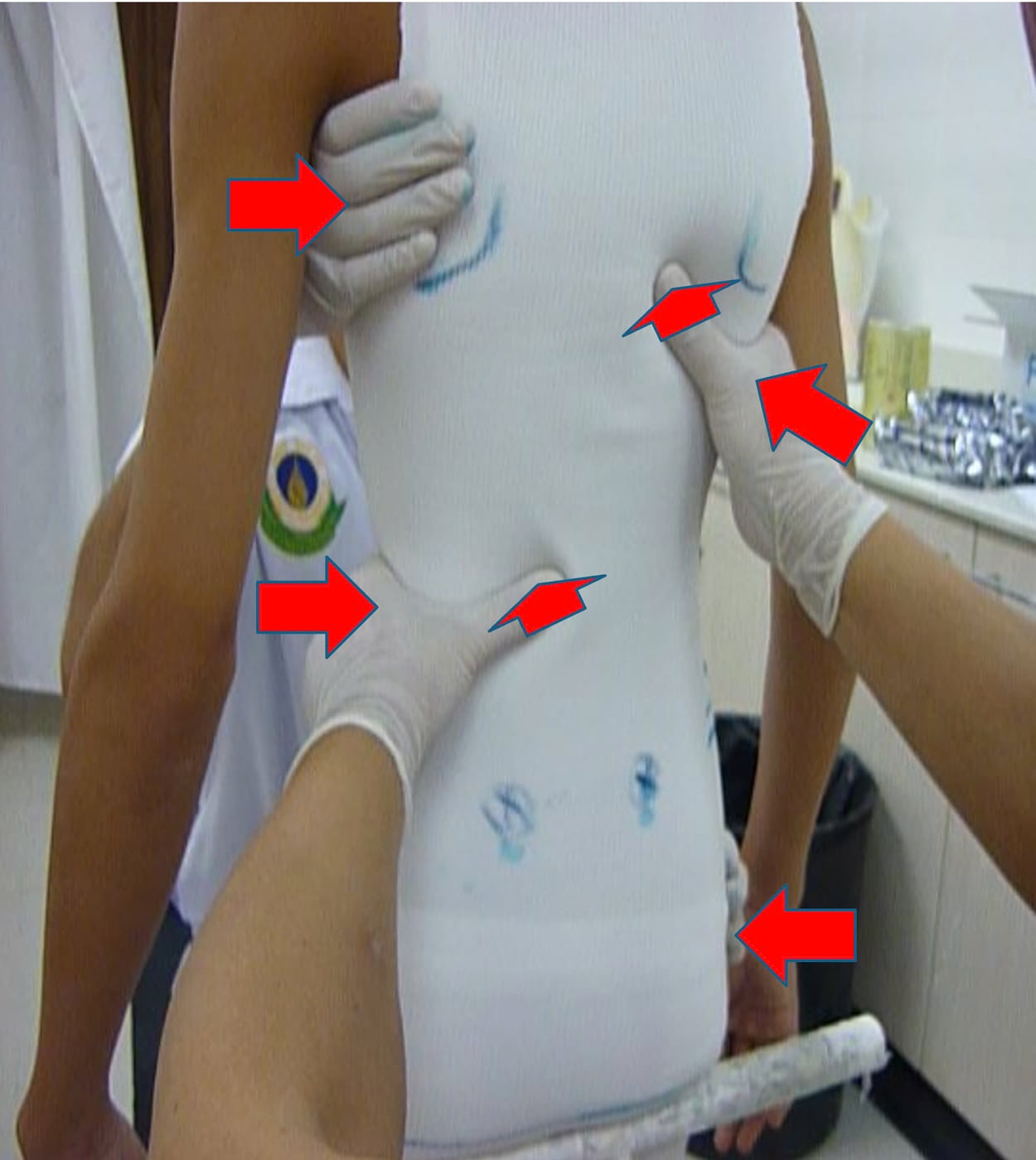
With plaster casting the correction is made from the mould itself, so little modification is needed and the brace fits the body more closely and accurately.
A balanced word on the evidence is needed: direct comparisons of the two ways of capturing the shape are few and do not yet answer the question above. A study on rigid mannequins (Kumagai et al., Neurospine 2026) found that braces made from a 3D scan fitted the model more closely (smaller gaps, especially in curved areas) and were faster to make (about 55 versus 100 minutes); a rigid mannequin has no curve to correct, so it cannot measure the benefit of hands-on correction while casting. A retrospective French study of 101 Garches braces for 32 children (Viallard et al., Prosthet Orthot Int 2026) found no significant difference in Cobb-angle change, number of fittings or skin problems between plaster casting and 3D scanning, and staff preferred scanning for the child’s comfort; that group was children with neuromuscular disease, not adolescent idiopathic scoliosis. The reason for preferring a hands-on corrective mould here is therefore a mechanistic argument based on clinical practice, not a conclusion from a direct trial in AIS; good results still depend on the orthotist’s skill whichever method is used. Corrective plaster casting remains widely used in spinal orthotic practice in many developed countries, including Europe and the USA, while 3D-printed braces are the newer approach.
The scientific evidence: 3D-printed braces have not shown an advantage
The effectiveness of bracing in general has strong evidence. But that evidence was built on custom vacuum-formed braces; 3D-printed braces have only a few small, short-term studies.
- BrAIST (Weinstein et al., New England Journal of Medicine, 2013): 72% avoided surgery in the braced group versus 48% in observation; 90–93% when the brace was worn more than 13 hours a day.
- Cochrane review (Negrini et al., 2015): pooled 7 studies with 662 adolescents, assessing rigid braces against observation and other treatments.
- SOSORT 2016 guidelines: 68 recommendations, 25 on bracing, recommending that bracing be delivered by a team specialised in conservative spine treatment.
CAD/CAM and 3D-printed braces compared with conventional manufacture
Overall: 3D-printed braces give comparable short-term results, sometimes slightly better or worse, but with no clear difference. Most studies have fewer than 50 patients, measure only immediate correction and do not follow patients to skeletal maturity. The one large randomised trial registered in China (ChiCTR1900027379) has not yet published results.
The 2011 SOSORT guidelines also noted that studies comparing CAD/CAM with plaster moulding are converging on one conclusion: how a brace is made does not affect the final outcome or the patient's perception. In other words, digital technology does not make the brace better, so there is no scientific basis to pay extra for a “3D brace” expecting higher effectiveness. The guidelines also advise each team to use the type of brace it understands and masters best, since no type is currently recommended over others.
| Study | Design, sample | Main result |
|---|---|---|
| Systematic review, 2025 | Meta-analysis of 11 trials, 469 patients | Treatment superiority of CAD/CAM braces (including 3D-printed) not demonstrated |
| Scoping review, Maastricht, 2025 | 42 studies (18 clinical) | Inconsistent outcome measures, short follow-up, fragmented validation |
| Systematic review, Children, 2023 | 5 RCTs, 4 pooled | In-brace correction differed by only 0.6° (95% CI −1.06° to 2.25°); CAD/CAM no better than manual |
| Hong Kong RCT (SRS meeting) | RCT, 30 patients, Cobb 25–45° | Comparable effectiveness; printed brace lighter, thinner, better adherence. Published only as a conference abstract |
| Alberta RCT, Canada | Planned 50, actual 10 patients | Immediate in-brace correction only; 3 of 4 curves reached the 50% threshold |
| Prospective study, World Neurosurgery | Non-randomised, 55 vs 48 patients | Printed group progressed less with higher quality of life; non-randomised design prone to selection bias |
| Wong et al., 2005 | 40 patients (CAD/CAM vs manual) | In-brace Cobb reduction 41.9% vs 32.1%; difference not statistically significant |
3D-printing materials: long-term reliability is unverified
The thermoplastics used in vacuum-formed braces (polyethylene, polypropylene) have been used for decades on millions of patients. Their durability, tolerance of 18–23 hours of wear a day and skin compatibility are established. By contrast, printed materials (such as nylon PA12) still raise open questions:
- A 2022 Frontiers study: printed braces give good immediate results, but long-term effectiveness still needs time to be clarified.
- Layer-by-layer structure is weaker between layers and prone to cracking under repeated load over thousands of hours of wear.
- No study has followed printed braces to skeletal maturity, let alone decades of data like the 24.7-year study of Lange et al. with the Boston brace.
For this reason the orthotics profession still regards printed braces as a technology under validation, not yet reliable enough to replace vacuum-formed braces.
Long-term data on custom rigid braces
The two large studies below show that custom rigid braces are effective and safe in the long term. Both were done with conventional vacuum-formed braces; there is no equivalent data for 3D-printed braces.
Systematic review and meta-analysis by Costa et al. (Journal of Clinical Medicine, 2021): 33 studies, of which 16 at low or moderate risk of bias were pooled. Success was defined as curve progression of no more than 5°.
| Type of brace | Success rate (95% CI) |
|---|---|
| Rigid night brace (Charleston, Providence) | 78.7% (72.4–85.0%) |
| Rigid full-time brace (Boston, Chêneau, Lyon…) | 73.2% (60.9–85.5%) |
| Soft brace (SpineCor) | 62.4% (55.1–69.6%) |
| Observation only, no brace | 50% (44–56%) |
- Material stiffness matters: in head-to-head studies the soft SpineCor brace succeeded in 8–65%, versus 80–94.4% for rigid TLSOs.
- Several design principles work: night braces are comparable to full-time braces; Chêneau reached 76–86% in four studies and Boston 51–83%. This supports choosing and combining principles case by case.
- Timing: 71% success when starting at Risser 0–2 and 75% at Risser 0–3, but only 60% across all Risser stages.
- Hours of wear: with the Boston brace, more than 12 hours a day succeeded in 82%, 7 hours in only 31% (Katz et al.).
- Correction target: day braces aim for at least 50% in-brace correction; night braces aim for about 70% or more.
24.7 years after Boston brace treatment
Lange et al. (Scoliosis, 2011) followed 272 patients in Oslo, Norway, for an average of 24.7 years (16–32 years); mean age at review was 40.4.
- Mean main curve 33.2° before treatment, 28.3° at brace weaning and 32.5° after more than 20 years: the curve stayed stable through adulthood.
- 69% did not progress more than 6° and 26% improved by 6° or more; only 9% needed surgery.
- 76% worked full-time and 87% had had children: scoliosis did not affect pregnancy and childbirth.
- Quality of life was largely within normal limits (SRS-22 pain 4.1/5, mental health 4.1/5). Those with curves of 45° or more, or who had surgery, rated their body image lower.
Limitations to state: the Lange study had no control group. Costa et al. also note that most bracing studies carry a considerable risk of bias; even so, success rates did not depend on study quality.
Other sources pointing the same way
- BrAIST, full text (Weinstein et al., NEJM 2013): the trial was stopped early because bracing was clearly effective. In the randomised group, success was 75% with bracing versus 42% with observation; average wear of 12.9 hours a day or more gave 90–93%.
- Rigid beats soft (Canavese and Kaelin, 2011, citing Wong et al.): for curves of 20–30°, after 45 months 31.8% of patients in the soft SpineCor brace progressed by 5° or more, versus 4.7% in the rigid brace group.
- Boston and Chêneau braces (Bettany-Saltikov et al., 2017): about 70% success with Boston and over 90% with a standard Chêneau. Adherence and initial in-brace correction are the two decisive factors.
- Providence night brace (Davis et al., 2018): 57.1% success in 56 patients. Apex at T10 or below and Risser 1 or above were good prognostic factors, showing the need to choose the right brace for each curve pattern.
- Moulding under corrective force (Schiller et al., 2010): the Providence brace is plaster-moulded on a frame while corrective force is applied to the spine, and only then built in polypropylene; in-brace correction reached 96% for the main curve. This is exactly the “correct at the moment of moulding” principle of plaster casting.
Insurance: paying for the custom brace, not extra for the technology
In the United States, since February 2024 CMS guidance states that a 3D-printed brace may be paid under the custom-made brace code only when it meets all the quality criteria of a custom-made brace: made for one patient, based on a clinically modified mould, measurements or image. The same authority makes it clear that 3D printing is only a fabrication technique and is not by itself enough for a product to count as “custom-made”. This has three implications:
- A 3D-printed brace has no separate payment code and is not paid more than a vacuum-formed brace; it shares the custom spinal brace code (for example L1300, a brace moulded to the patient's model).
- The benchmark remains the current custom-made brace; a printed brace must show it meets that standard before payment.
- Insurers regard 3D printing as a manufacturing method, not a new treatment that gives higher effectiveness.
In other words, a patient who pays extra for a “3D brace” is paying for technology, not for a proven treatment benefit. If printed braces were truly superior, developed countries would have a very strong incentive to replace plaster and vacuum forming entirely: machines run day and night, labour is freed, training costs fall. In reality plaster-moulded vacuum-formed braces remain the common choice and printed braces are accepted only as “equivalent”.
Cost: why 3D-printed braces are more expensive in Vietnam
The economic advantage of 3D printing depends on the balance between machine cost and labour cost, and in Vietnam that balance is the reverse of developed countries.
| Factor | Developed countries | Vietnam |
|---|---|---|
| Scanner, software, printer | Relatively cheap against income | Expensive, imported, software licences paid in foreign currency |
| Technical labour | Very expensive | Much lower |
| Training in digital technology | Systems already exist | Extra cost and time |
| Printing material | Readily available | Mostly imported |
| Outcome | Lower cost, higher production efficiency | Higher price per brace than vacuum-formed |
Even in Canada the value depends on the model: a printed brace is 37% cheaper when printed in-house but 27% more expensive when outsourced (University of Alberta). The core advantage of 3D printing is therefore optimising production and finance where labour is expensive, not a treatment benefit to the patient. In Vietnam, patients usually pay more for a product with no proven superior effect.
Advantages and disadvantages of the two methods
Custom vacuum-formed braces are strong on evidence, durability and adjustability; 3D-printed braces are strong on production speed, weight, thinness and appearance, but have not shown a treatment advantage.
| Criterion | Custom-made (plaster, vacuum-formed) | 3D-printed |
|---|---|---|
| Evidence of effectiveness | Basis of BrAIST, Cochrane, SOSORT; over 20 years of follow-up | A few small short-term studies; equal, slightly better or worse, no clear difference |
| Moulding | Corrected directly on the body at casting; the mould already reduces the curve | Records the curved trunk only; cannot act on the body |
| Model modification | Little, guided by the practitioner's feel | Much on computer; larger errors and more risk of pressure pain |
| Material, durability | Thermoplastic proven and refined over decades, uniform strength | Weak at layer bonds; no long-term durability or safety data |
| Adjusting as the child grows | Heat, reshape, add or remove padding easily | Limited; major change usually means reprinting |
| Weight, thickness | Thicker and heavier | About 30% thinner and 26% lighter (Frontiers, 2022) |
| Ventilation, appearance | Holes drilled by hand | Ventilation holes and patterns easy to design |
| Production speed | Depends on the practitioner's working hours | Printer runs day and night; less labour |
| Cost in Vietnam | Lower, suited to local labour | Higher: machines, software, imported materials and training |
| Insurance (US) | The benchmark for payment | Paid only when shown to meet the custom brace standard; nothing extra |
Developed countries such as the US, UK and Europe still mainly use custom vacuum-formed braces; digital technology is introduced chiefly to save labour in some steps.
The deciding factor: the person who examines, designs and makes the brace
The literature identifies four factors that influence bracing outcomes: risk of progression by age and curve size, the amount of in-brace correction, hours of wear, and quality of wear. Design quality decides correction and comfort, and so indirectly whether the child is willing to wear the brace. No technology replaces these four steps:
- Examination and assessment: reading X-rays, locating the apex, Cobb angle, vertebral rotation, Risser stage and curve flexibility.
- Prognosis and goal setting: in a growing child (Risser below 3) the aim is to reduce the curve, not just hold it; “holding” is reserved for severe, rigid or skeletally mature cases.
- Designing the corrective forces: combining several principles (Boston, Chêneau, Milwaukee, over-correcting night braces) to suit each curve, rather than applying a single school.
- Trial, fine-tuning and follow-up: in-brace X-rays, adjusting pressure areas, replacing the brace as the child grows and guiding exercise.
The SOSORT standard for the person making the brace
SOSORT sets very specific requirements for the prosthetist-orthotist (CPO) who makes spinal braces: at least 2 years of continuous work with the same experienced physician; at least 2 years of continuous practice in spinal bracing; and at least 2 braces a week, about 100 a year, over the last 2 years. None of these requirements mentions the type of machine used. SOSORT stresses that experience and preparation are the only way to avoid risk to patients and achieve good results. Other recommendations in the guidelines:
- The brace must be designed specifically for the curve pattern being treated (grade A).
- At every check, correction must be assessed in all three planes: frontal, sagittal and transverse.
- Brace quality must be verified with an in-brace X-ray.
- Every stage, including prescription, manufacture, checking, adjustment and follow-up, must be carried out carefully for each individual brace (grade A).
Three details that show why skill matters
- Assessment before making the brace determines correction. He et al. (PLoS ONE 2017) showed that spinal flexibility in the prone position correlates strongly with initial in-brace correction (r = 0.75), but almost not at all in the bending position (r = 0.03–0.04). The practitioner must assess correctly to set the right goal for each case.
- The curve changes during treatment. Zheng et al. (Eur Spine J 2012) followed 141 patients in Boston or Milwaukee braces: apex, length and pattern of the curve can change, especially in skeletally immature children, and the brace must then be modified. Vacuum-formed braces have the advantage that they can be heated, reshaped and re-padded in the clinic.
- Growth assessment. Cheung and Luk (Asian Spine J 2017) stress wearing the brace through the period of fastest growth and stopping when growth ends, to avoid unnecessarily long wear.
A clinical case from our clinic
A 14-year-old boy with an S-curve of 41° and 33° Cobb responded very well to a custom-made brace. After 8 months without wearing it, the curve rose to 48° and 37°. The family switched to a 3D-printed brace hoping their son would be more comfortable and cooperative; some time later the lower curve improved slightly but the upper curve kept increasing, so the family chose to return to a custom-made brace using the traditional method.
The case shows that whatever the technology, patient adherence and the skill of the person making the brace remain decisive. One case cannot settle the question of a technology; we present it as a practical illustration, not statistical evidence.
Conclusion
The custom-made brace, moulded by plaster and vacuum-formed from thermoplastic, remains the validated and widely used standard in developed countries. The 3D-printed brace is a promising direction for weight and appearance, but has no evidence of superior effectiveness, and the major insurers treat it only as a manufacturing technique. For any individual case, the quality of the brace is decided by the expertise of the person who examines, designs and makes it.
| Term | What it really means | What to understand correctly |
|---|---|---|
| “2D brace” | Classic single-principle brace (Boston, Milwaukee, Charleston, Chêneau), correcting mainly two planes | Not a name for plaster-moulded braces; every brace is a three-dimensional object |
| “3D brace” (3D-printed) | A brace scanned, designed and printed by machine | A manufacturing method that does not guarantee three-plane correction; superior effectiveness not proven |
| Custom-made brace | The practitioner combines all principles to correct three planes, plaster-moulded with correction and vacuum-formed | Used in the US, UK, France, Germany and Europe; the benchmark for every new technology |
The question to ask before choosing a brace
In short, there are several things parents should know about 3D-printed braces before choosing:
- No evidence of superior effectiveness; studies are small and short-term.
- Printed materials have not been verified for long-term durability and safety; they are weak at the layer bonds.
- 3D scanning cannot correct the body during moulding; heavy computer modification means larger errors and more risk of pain and pressure.
- Machines and software lack the clinical feel of the person making the brace, and are harder to adjust as the child grows.
- In Vietnam they cost more than vacuum-formed braces; insurers in developed countries recognise printed braces only when they meet the plaster-moulded standard and pay nothing extra for the technology.
The main advantages of 3D-printed braces are fast production, continuous machine operation and a lighter, thinner brace. These are manufacturing benefits, not treatment benefits that have been proven.
If your child has been prescribed a brace or you are weighing the options, bring the X-rays for an in-person examination and consultation. We will explain the curve pattern, the correction goal and why we choose each type of brace, so the whole family can pursue treatment with confidence.
References
- Weinstein SL, Dolan LA, Wright JG, Dobbs MB. Effects of bracing in adolescents with idiopathic scoliosis (BrAIST). N Engl J Med. 2013;369:1512–1521.
- Negrini S và cs. Braces for idiopathic scoliosis in adolescents. Cochrane Database Syst Rev. 2015;(6):CD006850.
- Negrini S và cs. 2016 SOSORT guidelines: orthopaedic and rehabilitation treatment of idiopathic scoliosis during growth. Scoliosis Spinal Disord. 2018;13:3.
- Negrini S, Aulisa AG, Aulisa L và cs. 2011 SOSORT guidelines: orthopaedic and rehabilitation treatment of idiopathic scoliosis during growth. Scoliosis. 2012;7:3.
- Costa L, Schlosser TPC, Jimale H, Homans JF, Kruyt MC, Castelein RM. The effectiveness of different concepts of bracing in adolescent idiopathic scoliosis (AIS): a systematic review and meta-analysis. J Clin Med. 2021;10(10):2145.
- Lange JE, Steen H, Gunderson R, Brox JI. Long-term results after Boston brace treatment in late-onset juvenile and adolescent idiopathic scoliosis. Scoliosis. 2011;6:18.
- Efficacy of CAD/CAM-based braces for adolescent idiopathic scoliosis: a systematic evaluation and meta-analysis. 2025.
- Hoelen TCA và cs. The methodology and application of three-dimensional technology in brace design and production for AIS: a scoping review. 2025.
- Can CAD/CAM integrating with/without biomechanical simulation improve the effectiveness of spinal braces on AIS? Children. 2023;10(6):927.
- 3D-printed spinal orthosis in management of AIS: a randomized controlled trial. Scoliosis Research Society meeting abstract, University of Hong Kong.
- A new spinal brace design concept for the treatment of AIS. ClinicalTrials.gov NCT03365804, University of Alberta.
- Immediate outcomes and benefits of 3D printed braces for the treatment of AIS. Front Rehabil Sci. 2022.
- Patient-specific 3D-printed brace for AIS: a prospective cohort study. World Neurosurgery (summary in The O&P EDGE).
- Wong MS, Cheng JCY và cs. A comparison of treatment effectiveness between the CAD/CAM method and the manual method for managing AIS. Prosthet Orthot Int.
- Wong MS và cs. A work study of the CAD/CAM method and conventional manual method in the fabrication of spinal orthoses for AIS.
- A novel 3D printed brace manufacturing process for the treatment of AIS. Thesis, University of Alberta.
- 3D-printed brace in the treatment of AIS: a study protocol of a prospective RCT. BMJ Open. 2020;10:e038373.
- He C, To MKT, Cheung JPY và cs. An effective assessment method of spinal flexibility to predict the initial in-orthosis correction on the patients with AIS. PLoS ONE. 2017;12(12):e0190141.
- Zheng X, Sun X, Qian B và cs. Evolution of the curve patterns during brace treatment for adolescent idiopathic scoliosis. Eur Spine J. 2012;21:1157–1164.
- Bettany-Saltikov J, Turnbull D, Ng SY, Webb R. Management of spinal deformities and evidence of treatment effectiveness. Open Orthop J. 2017;11:1521–1547.
- Canavese F, Kaelin A. Adolescent idiopathic scoliosis: indications and efficacy of nonoperative treatment. Indian J Orthop. 2011;45(1):7–14.
- Davis L, Murphy JS, Shaw KA và cs. Nighttime bracing with the Providence TLSO for treatment of AIS: a retrospective consecutive clinical series. Prosthet Orthot Int. 2018.
- Schiller JR, Thakur NA, Eberson CP. Brace management in adolescent idiopathic scoliosis. Clin Orthop Relat Res. 2010;468:670–678.
- Cheung JPY, Luk KDK. Managing the pediatric spine: growth assessment. Asian Spine J. 2017;11(5):804–816.
- CGS Medicare. 3-D printed orthotic devices – correct coding. 02/2024.
- CGS Medicare. Policy update 03/2024 on 3D-printed devices.
- Noridian Medicare. Scoliosis brace – correct coding – revised. 2025.
- Kumagai N, et al. Comparative accuracy assessment of thoraco-lumbo-sacral orthosis fabrication: conventional contact casting versus noncontact 3-dimensional digital scanning. Neurospine. 2026. PMID 42097748.
- Viallard L, et al. Comparison of efficacy, tolerance, and professionals’ opinions between plaster casting and 3D scanning in manufacturing the Garches brace. Prosthet Orthot Int. 2026 (France). PMID 41668253.
- Raux S, et al. Tridimensional trunk surface acquisition for brace manufacturing in idiopathic scoliosis. Eur Spine J. 2014 (France). PMID 24806260.
- Hình ảnh minh họa / Illustrations: dungcuchinhhinh.vn (website của Lê Hoàn Prosthetics & Orthotics)
Related solutions

Answering Common Questions About Scoliosis
Answers to parents' most common questions about scoliosis bracing: when one or two braces are needed, why braces must be replaced periodically, and why wear continues even after the spine straightens.
Answering Common Questions About Scoliosis
How Orthotic Bracing Is Used to Treat Scoliosis
An overview of scoliosis — causes, warning signs, and health risks — and why orthotic bracing combined with physical therapy is today's safest, most effective treatment.
How Orthotic Bracing Is Used to Treat Scoliosis
An Overview of Custom Orthotic Insoles for Flat Feet
Causes, benefits, and the treatment process for flat feet using custom orthotic insoles — plus notes on cost and when this approach is truly appropriate.
An Overview of Custom Orthotic Insoles for Flat FeetDo you or a loved one need advice?
Book an in-person assessment in Hanoi or send your file for a remote consultation. We reply within 24 hours.