Prosthetic limbs
Above-Elbow Prosthetic Arm: Structure, Classification and Myoelectric Technology
An above-elbow prosthetic arm consists of a socket, elbow joint, forearm and hand, classified by amputation level, function and material — myoelectric technology allows natural control using the wearer's own remaining muscles.

An above-elbow prosthetic arm replaces the arm from the elbow upward for people who have lost the limb through congenital condition, accident, or illness. Structurally, it typically includes a socket (made of plastic, silicone or other materials, which holds the prosthesis in place and provides comfort), an elbow joint (passive or active, controlled by residual muscle or by electric motor), a forearm section (connecting the elbow joint to the prosthetic hand), and a prosthetic hand (passive, or capable of finger movement).
By amputation level, above-elbow prostheses are categorized for shoulder-level amputation, elbow-level amputation, and below-elbow amputation. By function, there are cosmetic prostheses (focused on appearance, usually made of silicone or plastic, with no moving parts) and functional prostheses (enabling daily activities such as eating, personal hygiene, and grasping objects). By control mechanism, there are mechanical prostheses (using cables and springs, lower cost but limited function) and electric prostheses (using electric motors, more flexible function but higher cost). By material, prostheses can be made of plastic (affordable, but lower durability and cosmetic quality), silicone (soft, highly realistic appearance), or carbon (durable, lightweight, and the most expensive option).
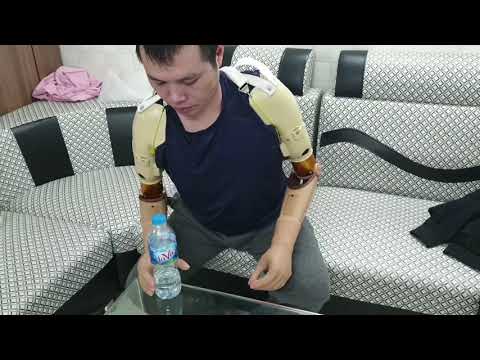
Myoelectric prosthetic technology represents a major advance: electrodes pick up electromyographic signals from the remaining muscle in the residual limb to open and close the prosthetic hand, letting users grasp and manipulate objects in daily life using their own remaining muscles. At the clinic, some patients have been fitted with a pair of myoelectric above-elbow prostheses and become proficient after just a few days of practice; others use a combination of one electric and one mechanical prosthesis on each side.
To use an above-elbow prosthesis effectively, users should clean the residual limb and socket before donning it, secure the prosthesis properly with straps or the appropriate mechanism, then practice regularly, progressing from simple tasks like grasping objects to more complex ones, ideally under the guidance of a physical therapist. A well-fitted prosthesis not only improves daily function but also helps users feel more confident and reintegrate into society more easily.
Lê Hoàn Prosthetics & Orthotics has more than 20 years of experience providing above-elbow prostheses — mechanical, electronic and myoelectric — with an experienced technical team and dedicated consultation, fitting and maintenance services. Call 0985211888 for support.
Videos from the Lê Hoàn YouTube channel

Related solutions

Hip Disarticulation Prosthesis
A hip disarticulation prosthesis restores mobility for people who have lost their entire lower limb from the hip joint, using modern socket design to rebuild standing and walking ability.
Hip Disarticulation Prosthesis
Fitting an Ankle Disarticulation Prosthesis
An ankle disarticulation prosthesis serves the lowest amputation level of the leg, preserving maximum natural weight-bearing function. Learn the fitting process and who needs this type of prosthesis.
Fitting an Ankle Disarticulation Prosthesis
A Trusted, Quality Address for Premium Prosthetic Legs
What a premium prosthetic leg is, the benefits it offers users, and why Lê Hoàn Orthotic Devices is a trusted choice for premium prosthetics.
A Trusted, Quality Address for Premium Prosthetic LegsDo you or a loved one need advice?
Book an in-person assessment in Hanoi or send your file for a remote consultation. We reply within 24 hours.