Prosthetic limbs
Both legs amputated – one above the knee, one below – yet walking like anyone else
 Lê Ngọc Hoàn Doctoral candidate · Master's · Engineer in Prosthetics & Orthotics — International practice certification CPO – ISPO Category I
Two real videos of one patient with both legs amputated (one above, one below the knee) walking without crutches or a cane – and the scientific evidence on how the socket, suspension, knee, alignment and training make it possible.

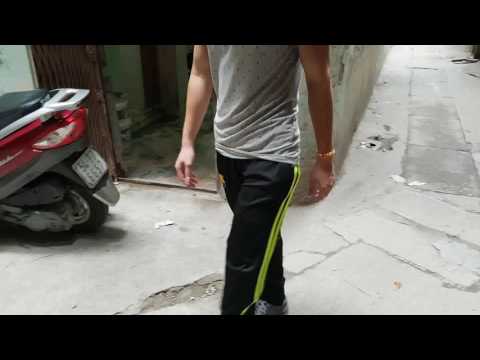
This article presents two real videos of the same patient: a young man who lost both legs, one above the knee and one below the knee. In long trousers, almost nobody would notice that the person walking in front of them has two prosthetic legs.
Identifying details have been removed. This is a single case and does not replace scientific evidence; each person's result depends on age, cause of amputation, residual limb, muscle strength and training.
Two videos, one person
The first video (2015) was filmed in shorts, so both prostheses can be seen clearly, from the sockets and the knee joint down to the feet. The second video (2017) was filmed in long trousers while the patient walks along a narrow alley in Hanoi, with no crutches and no cane.
Side by side, the two videos show what matters most: even steps, both sides symmetrical, an upright trunk, no hip swing, no need to look down at the feet. Only in shorts does the viewer see the whole "machine" doing the work of the real legs.
Why is this an especially difficult case?
A person with one amputation always has a sound leg to stand on: it carries most of the body weight, keeps balance and makes up for what the prosthesis cannot do. A person with two amputations has no such support.
A study in Prosthetics and Orthotics International (the journal of the International Society for Prosthetics and Orthotics – ISPO) describes people with bilateral amputation as a small but very challenging group in prosthetic rehabilitation, because they lack compensation from a sound limb and the two prostheses must be synchronised. In the UK they make up only about 6% of lower-limb prosthetic referrals, and the level of amputation is the key factor in their walking ability.
An above-knee amputation costs much more energy
The classic study by Waters and colleagues (Journal of Bone and Joint Surgery, 1976) showed that the lower the level of amputation, the better the walking. A systematic review and meta-analysis by Ettema and colleagues (Prosthetics and Orthotics International, 2021) quantified the energy cost of walking compared with people without amputation:
| Group | Energy cost of walking compared with people without amputation |
|---|---|
| Below-knee, non-vascular cause | about 12% higher |
| Above-knee, non-vascular cause | about 41% higher |
| Below-knee, vascular cause | about 36% higher |
| Above-knee, vascular cause | about 102% higher |

How to read the table: the bigger the number, the more effort each step takes compared with a person without amputation. The patient in the videos carries both burdens at once – one above-knee and one below-knee prosthesis – with no sound leg to help.
Genin and colleagues (European Journal of Applied Physiology, 2008) found a similar pattern: while walking, energy expenditure was 30–60% higher than normal in above-knee amputees and only 0–15% higher in below-knee amputees.
In reality, most people with both legs amputated use crutches, a cane or a wheelchair
- In 291 veterans with war-related bilateral leg amputation, followed for an average of 25.4 years (Prosthetics and Orthotics International, 2016), 88.3% still used a walking aid.
- In older people with bilateral amputation due to vascular disease or diabetes (Journal of Rehabilitation Research and Development, 2015), only 11% of those who walked before the second amputation could still walk after it, and every person with bilateral above-knee amputation lost the ability to walk.
Against these figures, the sight of this young man walking on his own, with no crutches and no cane, along a narrow alley is a result worth recognising.
What allows him to walk like anyone else? A biomechanical view
A prosthesis does not "know how to walk" by itself. For a person with two amputations to walk normally, every step of the work must follow sound biomechanical principles.
The socket: the foundation that transmits force
All body weight travels from the bone, through the soft tissue of the residual limb, into the socket and down to the ground. If the socket does not fit closely:
- the residual limb pistons up and down in the socket with every step, wasting energy and the feeling of control;
- pressure concentrates on a few points, causing pain, blisters and skin breakdown;
- the person loses confidence and turns to crutches.
With two amputations, both sockets must be equally precise: a small error on one side shifts the whole gait, because there is no sound leg to correct it.
Suspension: keeping the residual limb volume stable
The residual limb shrinks with activity. Board, Street and Caspers (Prosthetics and Orthotics International, 2001) measured residual limb volume in 10 below-knee amputees before and after a 30-minute walk: with an ordinary suction socket the limb lost an average of 6.5% of its volume, while with vacuum drawn through a one-way valve the volume was maintained. Beil and colleagues (2002) showed that the vacuum socket lowered positive pressure in stance phase and increased holding force in swing phase.
For above-knee prostheses, a systematic review by Gholizadeh and colleagues (2014) found no single "standard" suspension system for all above-knee amputees; the choice must be made for each patient. This is why a prosthesis must be customized, not bought ready-made and fitted.
Knee joint and alignment: controlling stance phase and swing phase
- In stance phase the prosthetic knee must be stable and never buckle unexpectedly: for a person with two amputations, a buckle means a fall, because there is no sound leg to catch it.
- In swing phase the knee must bend and straighten smoothly at walking speed, so the foot clears the ground and the gait looks natural.
- Both prostheses must be aligned together: height, foot angle, knee position relative to the weight line. A few millimetres or degrees off and the body compensates by swinging the hip or leaning the trunk.
In the second video, in long trousers, these compensations are almost absent – the result of good alignment.
Hip strength and training
People with two amputations rely on the hip muscles to replace the muscles lost in the thigh and lower leg. The study of 10 bilateral amputees mentioned above found a trend: the stronger the hip, the better the walking. A good prosthesis is only half of the result; the other half is a customized training programme: balance, weight shifting, stepping, then real terrain (slopes, stairs, uneven ground).
Long-term result
The patient was first fitted in 2010, at the age of 23. After about a year the residual limbs shrank naturally and new sockets were needed, but the skin stayed healthy and undamaged, and he kept walking without any aid. The videos from 2015 and 2017 show that this result lasted for many years.
Being honest with patients: not everyone gets there at once
Age, cause of amputation, length and quality of the residual limb, muscle strength and commitment to training differ from person to person. Studies show that younger people with non-vascular amputation usually have a better outlook. Even so, when the sockets are designed precisely, the components are chosen correctly, both prostheses are aligned together and the person trains properly, someone with two amputations can return to an almost normal life.
Videos from the Lê Hoàn YouTube channel

If you or a family member has lost a limb – one leg or both, above or below the knee – contact us for an in-person assessment and consultation: +84 985 211 888 (phone / Zalo).
References
- Bilateral lower-limb amputee walking ability and the role of hip strength (10 bilateral amputees; two-minute walk test, isokinetic hip strength). Prosthetics and Orthotics International.
- Waters RL, Perry J, Antonelli D, Hislop H. Energy cost of walking of amputees: the influence of level of amputation. J Bone Joint Surg Am. 1976;58(1):42–46.
- Ettema S, Kal E, Houdijk H. General estimates of the energy cost of walking in people with different levels and causes of lower-limb amputation: a systematic review and meta-analysis. Prosthet Orthot Int. 2021;45(5):417–427.
- Genin JJ, Bastien GJ, Franck B, Detrembleur C, Willems PA. Effect of speed on the energy cost of walking in unilateral traumatic lower limb amputees. Eur J Appl Physiol. 2008.
- Ebrahimzadeh MH, Moradi A, Bozorgnia S, Hallaj-Moghaddam M. Evaluation of disabilities and activities of daily living of war-related bilateral lower extremity amputees. Prosthet Orthot Int. 2016;40(1):51–57.
- Henson et al. Ambulation and independence among veterans with nontraumatic bilateral lower-limb loss. J Rehabil Res Dev. 2015;52(7):851–858. PMID: 26745753.
- Board WJ, Street GM, Caspers C. A comparison of trans-tibial amputee suction and vacuum socket conditions. Prosthet Orthot Int. 2001;25(3):202–209. PMID: 11860094.
- Beil TL, Street GM, Covey SJ. Interface pressures during ambulation using suction and vacuum-assisted prosthetic sockets. J Rehabil Res Dev. 2002;39:693–700.
- Baars ECT, Geertzen JHB. Literature review of the possible advantages of silicon liner socket use in trans-tibial prostheses. Prosthet Orthot Int. 2005;29:27–37.
- Gholizadeh H, Abu Osman NA, Eshraghi A, Ali S. Transfemoral prosthesis suspension systems: a systematic review of the literature. Am J Phys Med Rehabil. 2014;93:809–823. PMID: 24743451.
Related solutions

Hip Disarticulation Prosthesis
A hip disarticulation prosthesis restores mobility for people who have lost their entire lower limb from the hip joint, using modern socket design to rebuild standing and walking ability.
Hip Disarticulation Prosthesis
Fitting an Ankle Disarticulation Prosthesis
An ankle disarticulation prosthesis serves the lowest amputation level of the leg, preserving maximum natural weight-bearing function. Learn the fitting process and who needs this type of prosthesis.
Fitting an Ankle Disarticulation Prosthesis
A Trusted, Quality Address for Premium Prosthetic Legs
What a premium prosthetic leg is, the benefits it offers users, and why Lê Hoàn Orthotic Devices is a trusted choice for premium prosthetics.
A Trusted, Quality Address for Premium Prosthetic LegsDo you or a loved one need advice?
Book an in-person assessment in Hanoi or send your file for a remote consultation. We reply within 24 hours.